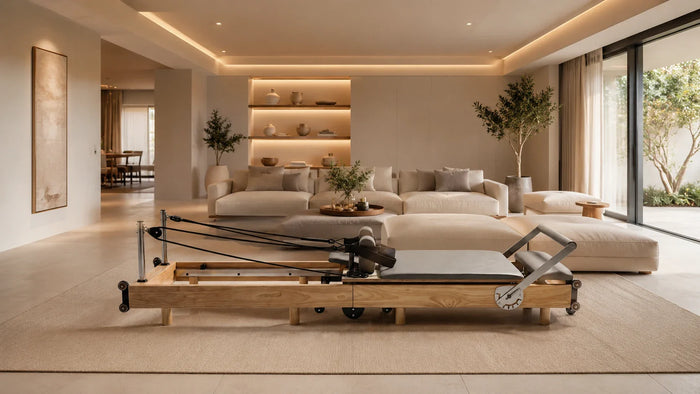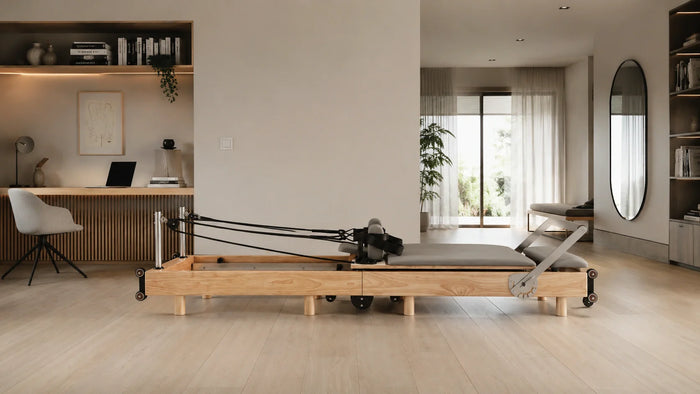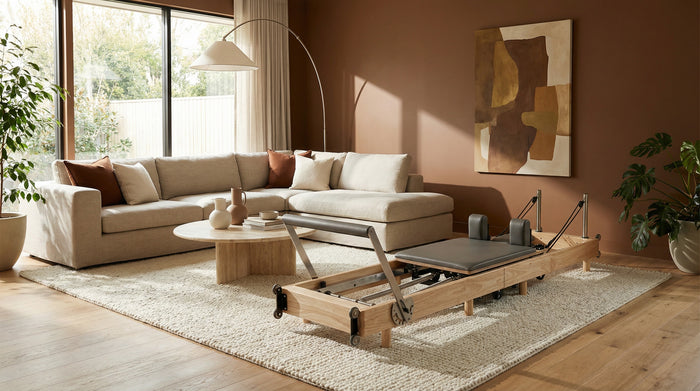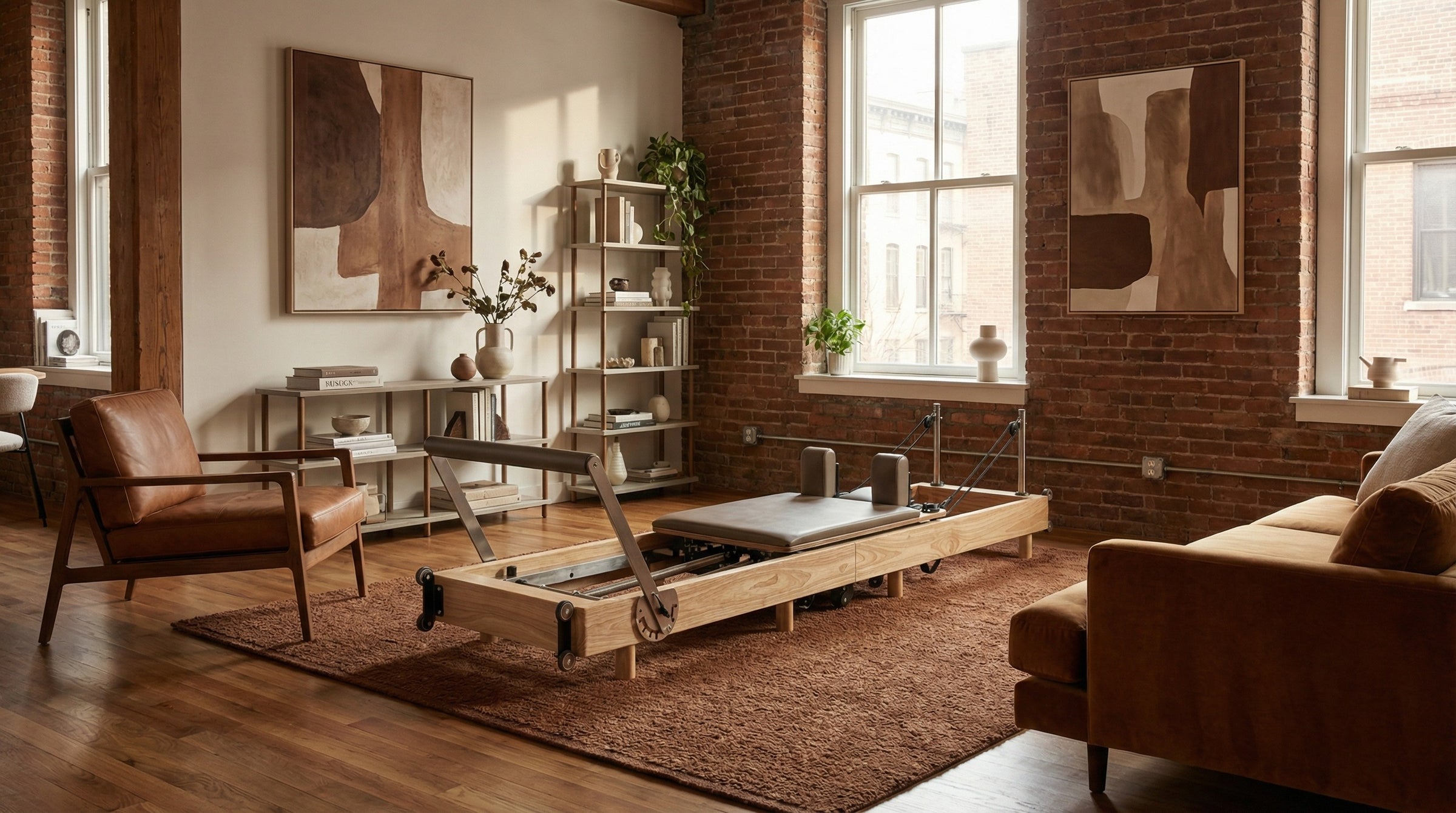
The idea of a home studio often conjures images of a generous spare room, timber floors, a wall of mirrors, and natural light from two directions. The reality, for most people, is a corner of a bedroom, a section of a garage, or a living room that has to serve multiple purposes throughout the day.
The good news: 10 square metres is more than enough. The NX901, footprint included, occupies roughly 2.5m × 0.65m when in use. That leaves space for a mat, movement, and — if you're thoughtful about it — a room that doesn't feel like a gym at all.
Start With the Floor
The surface beneath your reformer matters more than most people expect. Hardwood and polished concrete are ideal — they're easy to clean, they don't trap the reformer's feet, and they give the space a considered aesthetic rather than a makeshift one.
If your space has carpet, consider a hardwood or rubber panel that sits beneath the reformer only. This stabilises the carriage roll and makes the whole unit feel more planted. It also defines the practice area visually, which matters when the space doubles as something else.
What to avoid
- Thick foam tiles. They compress unevenly and can affect spring alignment over time.
- Deep pile carpet directly under the reformer. It restricts the carriage travel and creates uneven resistance.
- Rubber mats that extend beyond the reformer. They're harder to clean and make the space feel more clinical than it needs to.
Light as a Design Element
Natural light does more for a small practice space than any other single factor. A reformer beside a window — even a small one — creates a relationship with the outside world that makes the session feel less contained.
If natural light isn't available, consider warm-toned overhead lighting (2700–3000K) rather than cool white. Cool light in a small space signals "office" or "bathroom." Warm light signals "home."
"We have a north-facing window in what used to be the box room. The reformer faces it. On winter mornings when the sun comes through low, the whole session feels different — like practicing somewhere much bigger."
Storage and Dual Purpose
The NX901-MI folds to 1.2m × 0.65m — small enough to lean against a wall behind a closed door, or to slide under a high bed. If your space needs to function as a guest room, office, or children's play area outside practice hours, the fold-flat design means you're not making a permanent architectural commitment.
A few specific solutions that work well in small spaces:
- A low credenza or sideboard positioned at one end of the reformer serves as a visual anchor and a storage point for props — springs, straps, a rolled mat.
- A full-length mirror mounted on the wall adjacent to the reformer (not opposite — it creates a spatial illusion and means you can check your form in profile).
- A small shelf at shoulder height for your phone, a speaker, a glass of water. Practice has small rituals, and having a designated place for them makes the space feel purposeful.
The Reformer as Furniture
This is the design problem that Nexace was built to solve. A piece of equipment that looks like it belongs in the room — not stored in it — changes the calculation entirely. When your reformer has a frame finish that complements your existing furniture, when its upholstery reads as upholstery rather than gym padding, the question stops being "where do I hide it" and starts being "where do I put it."
The answer, in a 10 sqm space, is usually: right here, in the open, where it always was.